
Cambodian Workforce Recruitment Process
End-to-End Workflow from Recruitment to Placement
Step 1:Recruitment
(Recruitment)Host companies define required skills and job specifications. We align carefully to match exact business needs.
We advertise the positions locally in Cambodia. We conduct document screening and pre-selection interviews to find qualified candidates.
Step 2:Interview & Prep
(Interviews & Prep)Host companies conduct interviews with candidates. Once selected, domestic procedures for placement plan approval begin.
*If hiring candidates who already hold N5 or higher certificates, you can proceed directly to COE application (Step 4) after document transfers.
We assist in coordinating interviews. Selected candidates immediately begin intensive Japanese studies in preparation for travel.
Step 3:Language Exam & COE
(Japanese Exam & COE)Based on academic and qualification records sent from Cambodia, host companies apply for a Certificate of Eligibility (COE) with immigration.
Candidates undergo 4 months of strict Japanese training and take the JFT-Basic exam. Upon passing, credentials are sent to Japan.
Step 4:COE & Visa Application
(COE Approval & Visa)Following strict immigration reviews, the COE is issued. The original document is immediately mailed to Cambodia.
Upon receiving the original COE from Japan, we submit visa applications to the Embassy of Japan in Cambodia.
Step 5 & 6:Travel & Training
(Travel, Training & Employment)Host companies arrange housing and living infrastructure. Trainees complete a 1-month post-arrival orientation covering daily life rules and legal guidelines before commencing work.
We align the departure dates with the host company's timeline and coordinate travel logistics to Japan.
Advantages of Cambodian Talent & Key Operational Tips
Building a Sustainable Organization under Technical Intern & Specified Skilled Worker Systems
National Character & Cultural Compatibility
Top Reasons Why Japanese Enterprises Prefer Cambodian Workers
Youth & Growth Potential
Characterized by a highly active, youthful demographic structure.
Emerging growth center in the ASEAN region.
Cambodia Today
In contrast to Japan's aging population, Cambodia has a highly abundant young labor pool, driving expectations of continued economic growth.
Alongside agriculture and textile manufacturing, Cambodia's digital economy transition is progressing rapidly, drawing attention as an emerging business hub.
A nation combining rich cultural history (like Angkor Wat) with the dynamic energy of its youth.
Shared Spiritual Values
With over 90% of the population practicing Theravada Buddhism, Cambodians share many core values with the Japanese.
Gentle & Humble
About 90% are Theravada Buddhists.
Their polite, modest nature and emphasis on social harmony align extremely well with Japanese workplaces.
Respect for Elders
Deep respect for seniority and authority figures is ingrained in daily life, enabling smooth adjustment to Japanese organizational hierarchies.
Pro-Japan Sentiment
Thanks to decades of official development assistance (ODA), Cambodians hold high respect and aspiration toward working in Japan.
Work Ethic & Retention Rate
Cambodian workers are widely recognized for being exceptionally industrious and resilient.
Diligent & Persistent
Their ability to work reliably under challenging conditions is highly rated by host employers.
Strong Responsibility
Coming to Japan with clear goals to support their families back home, they exhibit low abscondment rates and high duty awareness.
Fast & Eager Learners
Their straightforward and receptive attitude allows them to absorb technical skills and safety rules quickly during OJT.
Linguistic & Educational Merits
Supporting Foundations for Seamless Communication
Communicative Benefits
Clear Pronunciation
Due to Khmer phonetic structures, Cambodians pronounce Japanese clearly, reducing instructions errors on busy production floors.
High Study Motivation
Japanese language study is highly popular. We attract top-tier talent aiming for professional career growth in Japan.
Institutional Potential
Strategic Career Steps from Trainee to Specified Skilled Worker
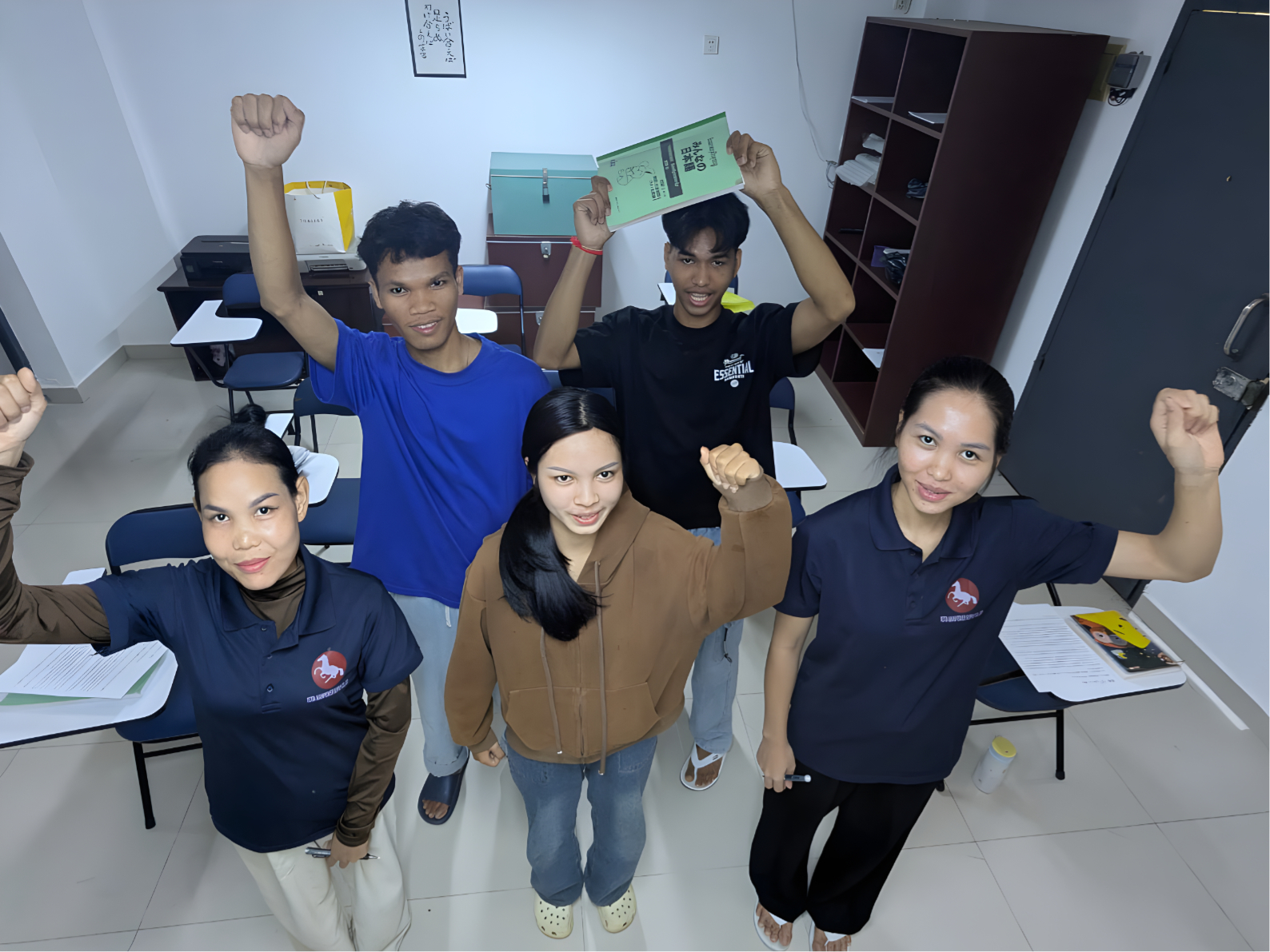
“Once a mutual relationship of trust is established, Cambodian workers become exceptionally loyal partners, working dedicatedly like a family.”
— Towards a Shared Future
Sectors & Support Systems
| Core Sectors | Key Performance Points | Sending Support |
|---|---|---|
| Agriculture, Construction, Auto | High physical capability and adaptability to outdoor environments. | Sectors-specific practical training pre-departure. |
| Food Processing & Mfg | Quick understanding of hygiene practices and team coordination. | Prior training in Japanese industrial standards. |
| Caregiving | Innate hospitality mindset and respect for the elderly. | Selected candidates reaching N4 to N3 proficiency. |
| Others | High cooperative character, fitting well into Japanese local communities. | Extensive pre-arrival living guidance and support. |
Cambodian Japanese N4 Certifications Trend (2016-2026)
| Year | July Certifications | December Certifications | Annual Total (Persons) |
|---|---|---|---|
| 2024年 | 1,482 | 1,813 | 3,295 |
| 2023年 | 1,120 | 1,652 | 2,772 |
| 2022年 | 305 | 684 | 989 |
| 2021年 | 128 | 392 | 520 |
| 2020年 | (中止) | 415 | 415 |
| 2019年 | 458 | 512 | 970 |
| 2018年 | 382 | 405 | 787 |
| 2017年 | 291 | 315 | 606 |
| 2016年 | 215 | 248 | 463 |
| 2015年 | 185 | 202 | 387 |
Trends & Insights
- 1
Exponential Growth
Compared to 2015 (387 certifications), the annual total has grown approx. 8.5 times by 2024 (3,295 certifications).
- 2
Specified Skill Influence
The growth between 2023 and 2024 is highly prominent, driven by the expansion of Specified Skilled Worker (SSW) exams in Cambodia and N4 qualifications required for nursing care and construction.
- 3
Success Rate Trends
While baseline exam takers have surged, the certification rate maintains a steady average of 30% to 40% globally, reflecting high-quality preparation.
Annual interest in working in Japan continues to rise,
leading to a growing number of students achieving N4 level proficiency.
Operational Tips for Success
While highly compatible, keeping the following cultural details in mind will build stronger workplace cooperation.
Avoid Public Reprimands
Self-esteem is highly valued. If correction is needed, explain the mistake gently and privately to preserve trust.
Align on Time Standards
Rather than simply demanding strict punctuality, explain the logical business benefits during orientation to ensure understanding.